No. 002 · Toyota · 1867–2026
Who pulls the cord? Toyota: the company built to expose its mistakes, and the year it hid them
A loom that stopped itself, a founder forced out by his banks, and a promise of quality that became too valuable to admit was broken.
The thesis
Toyota built its name on one habit: stop the work the moment something looks wrong. It started as Sakichi Toyoda's loom, became the andon cord on the assembly line, and helped turn a near-bankrupt truck maker into the world's biggest carmaker by 2008.
By then the name was worth more than any single car. In 2009, people inside Toyota found that a gas pedal could stick and prepared a fix. The company suspended it in the United States and, as it later admitted, kept the regulator from learning about the pedal. Months later it recalled 2.3 million vehicles; in 2014 it paid $1.2 billion to settle the case.
The procedures added afterwards did not prevent the certification scandals that followed at Daihatsu, Hino and Toyota itself. This case follows how a company built to expose its mistakes came to hide one, and what that cost.
On August 28th, 2009, on a highway outside San Diego, a man named Chris Lastrella called for help from inside a Lexus. The accelerator was stuck. The car was doing more than a hundred miles an hour, with four people inside. None of them survived.
Six months later, Akio Toyoda, the grandson of Toyota’s founder, raised his right hand before the United States Congress. Millions of his company’s cars were being recalled. He told Congress that every one of them carried his family’s name, and he admitted something chief executives rarely say out loud: his company had grown faster than it could teach its people.
That is the strange part. Toyota built its reputation on finding problems early, on letting any worker stop production the second something looked wrong. Some of what America believed that winter would turn out to be wrong. But some of it, Toyota had already found, and kept to itself.
So how does a company built to expose its mistakes become a company that hides them? The answer starts more than 140 years earlier, with a wooden loom.
The loom that stopped itself (1867–1930)
Sakichi Toyoda was born in 1867 in a farming village in central Japan. His father was a carpenter, and the eldest son was expected to become one too. But cheap foreign cloth was pouring into Japan, and Sakichi watched his mother work a hand loom for hours, earning almost nothing.
At eighteen he heard a teacher explain Japan’s new patent law: a country that cannot build its own machines will be swallowed by the ones that can. He decided to become an inventor. He had no training in mathematics and no money, and he had to hide it from his father. So he started with the only machine he had, the loom in his house. He could not work it out on paper. He could only watch it run, change one thing, and watch again.
It cost him nearly everything else. His first workshop went bankrupt. His first marriage broke up, and his baby son, Kiichiro, was raised by his grandparents. Twice, investors cut his research the moment business turned bad, and in 1910 they forced him out of the company that carried his name.
What he finally built answered a simple, expensive problem. When a single thread snaps on a power loom, the machine keeps running and weaves the flaw into yard after yard of ruined cloth. Sakichi built a loom that noticed. One broken thread, and the machine stopped itself. A machine that would rather stop than make something bad.
In 1929, the British firm Platt Brothers, whose looms had once beaten his in a trial, agreed to pay a hundred thousand pounds for the rights. By then Sakichi was weakened by a stroke. He had already made his son-in-law, Risaburo, the family heir, so he gave Kiichiro a project of his own. By the family’s account, he told him that everyone should attempt one great project in life. His had been looms. Kiichiro’s would be automobiles.
A father’s order: how Toyota started making cars (1930–1937)
It was a terrible idea on paper. A car has tens of thousands of parts. Japan had little suitable steel, almost no parts makers and few paved roads. Ford and General Motors were assembling close to thirty thousand cars a year inside Japan, while every Japanese maker combined built a few hundred. The country’s richest conglomerates had looked at the business and walked away.
Kiichiro fenced off a corner of the loom factory and quietly took apart an engine. Risaburo, who controlled the money, was certain cars would bankrupt them. Then, in late 1933, word came that Nissan was building a far bigger plant, and that the state would protect only companies that could build in volume. Kiichiro told the board the question was not whether Japan could build cars, but who. The board voted yes.
A year later he had spent five million yen, hired nearly a thousand people and not produced one car. The first engine made half the power of the Chevrolet engine it copied. Workers shaped body panels with hammers. Kiichiro did not manage from a desk; Toyota still tells how he pulled a handful of black sludge out of a broken grinder’s oil pan and told the worker you cannot do this job without getting your hands dirty.
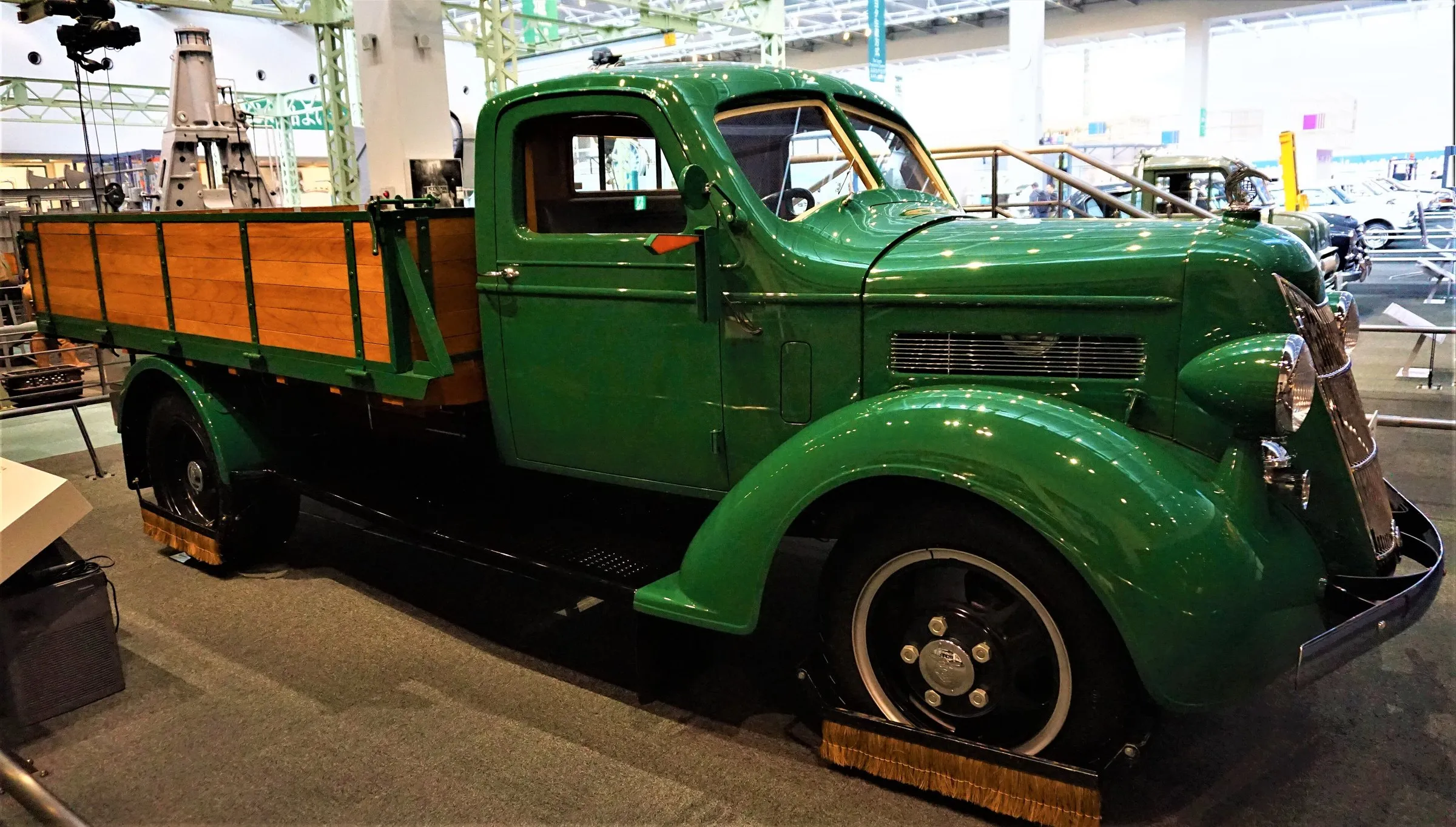
In May 1935 the first prototype was finished, and Kiichiro drove it alone to his father’s grave to report that the job was done. It was not. The trucks were so unreliable that the convoy to their own launch carried spare parts. When Toyota Motor was founded in 1937, its lots were full of unsold vehicles, until Japan went to war in China and the army bought every one.
1950: the strike that left Toyota a scar
After the war, Kiichiro had more than three thousand people depending on him and no idea whether the occupiers would let him build cars again. They planted crops in the factory yard, made pots and pans and farmed fish. Debts climbed to eight times the company’s capital. While firms across Japan fired workers by the thousand, Kiichiro offered his people a pay cut in exchange for no layoffs. They agreed.
The banks did not. Their price for a rescue was sixteen hundred jobs. In April 1950, Kiichiro told the union leaders himself that the fault was his alone. The workers walked out; sirens wailed across the plant. In June, he resigned. Two weeks after the plant restarted, war broke out in Korea, and the American military ordered trucks by the thousand. Kiichiro died in March 1952, months before he was due to return.
Outsiders had decided who stayed and who went, and the founder had paid for it. That year shaped everything Toyota did next.
How the Toyota Production System was born
Two men came home from 1950 with conclusions of their own. Eiji Toyoda, Kiichiro’s cousin, spent twelve weeks at Ford, which built eight thousand cars a day to Toyota’s forty. He expected to be impressed and found an empire coasting on old equipment. His report home: they are not doing anything we cannot understand.
The new president, Taizo Ishida, brought home fear, and turned it into a rule. Toyota would never again hire so many people that it had to fire them. If you want more cars, build them with the people you have. That rule would save Toyota more than once. It would also leave temporary workers carrying much of the cost.
Taiichi Ohno, a machine-shop manager, had to turn both demands into a factory that could match Ford without Ford’s money, space or market. He threw out big batches. Building on an idea Kiichiro had sketched before the war, he made only what the next step had just used, the way an American supermarket restocks a shelf. That became just-in-time. Then he added Sakichi’s idea: a cord above the line that any worker could pull to call for help, which would stop the line if the problem could not be fixed in time. That became the andon cord.
With no stockpile to hide behind, every mistake surfaced at once. The craftsmen hated it. Ohno made people who overproduced carry the extra parts home, and taught managers to see by having them stand in a chalk circle on the floor and watch, sometimes for eight hours.
Toyota still had to learn the last part the hard way. Rushed against Nissan, two generations of the Corona shipped so full of faults that Nissan dealers displayed used Coronas with the defects listed on a sign. Shoichiro Toyoda, Kiichiro’s son, argued that a family buying its first car needs it right the first time, and staked his name on building quality into every step. In 1965, Toyota won Japan’s top quality prize. Quality was becoming Toyota’s identity, which would later make admitting a defect feel like admitting the whole company had failed.
America: a failure, then a promise kept
In 1957, sales chief Shotaro Kamiya saw an opening in America’s suburbs and a door that would soon close. The Toyopet Crown landed in Los Angeles like a film star, then met an American freeway, overheated and could not keep up. In 1960 Toyota sold 316 cars in the entire United States.
It promised itself to return only with a car good enough for the world. The 1965 Corona was that car, then came the Corolla, and by 1971 Toyota was the third-largest carmaker on Earth. When President Nixon imposed an import surcharge that year and then lifted it, the government never paid the tax back. Toyota did, refunding every customer and dealer while its American arm struggled to make payroll.
What the rule cost the people on the line
By 1972 Toyota was building more than two million vehicles a year while keeping Ishida’s rule. Between 1970 and 1972, its output in Japan rose by almost a third and its workforce by about three percent. The difference came from overtime, supplier firms and seasonal workers on contracts of a few months.
The journalist Satoshi Kamata took one of those contracts and kept a diary, one critic’s account from one plant. A transmission reached his station every eighty seconds when he started, and every seventy-four when he left. Lost output came back as overtime. Ishida’s rule protected permanent jobs. It did not protect anyone from the pressure, and it raised a question that would matter decades later: a system that could stop the line for one bad part, did it hear its own workers as readily?
NUMMI: same workers, a different system
In the 1980s, General Motors asked Toyota to teach it how to build a small car. They chose a GM plant in Fremont, California, that had closed in 1982 with absenteeism of twenty to twenty-five percent and more than seven hundred unresolved grievances. The joint venture, NUMMI, rehired mostly the same people, including the entire union leadership.
What changed was the system. More than eighty job classifications became one. Small teams got leaders whose job was to help. The contract promised no layoffs unless survival was at stake, with managers taking pay cuts first. Future team leaders spent weeks at Toyota’s Takaoka plant, where one of them, Earl Ferguson, watched the line stop for a single cross-threaded bolt. One bolt, he said, changed his attitude.
Within two years NUMMI was the most productive car plant in America, needing about half the labor hours per car of the old plant. Absenteeism fell to around three percent. When sales slumped in 1988, it laid off no one. The cord was never the system. The trust was. General Motors tried to copy it by photographing a plant inch by inch. By 2009, GM was bankrupt.
Lexus and the 8,000-car recall
To win the wealthy customers who would not be seen in a Toyota, chief engineer Ichiro Suzuki set targets that contradicted each other: faster than a Mercedes, quieter and more fuel-efficient. Engineers laughed. He asked them to build just one engine, and it ran so smoothly that the doubters started working out how to mass-produce it.
The Lexus LS 400 went on sale in America on September 1st, 1989. Three months later, a handful of complaints came in. Toyota did not wait to see a pattern. It recalled all of them, about eight thousand cars, and flew technicians to owners who lived far from a dealer. Twenty years later it would face the same choice, and choose differently.
The Prius, and the climb to number one
In 1993, Toyota began imagining a car for the next century. Takeshi Uchiyamada pulled the specialists into one room to decide things together. The target rose from 1.5 times the efficiency of rivals to double, the car became a hybrid, and the launch was pulled forward a year. The first prototype took forty-nine days to move at all. The Prius still went on sale in December 1997, on time.
Growth became the goal. Toyota wrote its culture down as the Toyota Way 2001, because it could no longer pass from teacher to apprentice alone, and aimed for fifteen percent of the world market. Then came the cracks. In 2007, US regulators investigated floor mats that could trap a Lexus pedal. Toyota later admitted that its own investigation had found design features making entrapment more likely, and that it did not share them with the regulator. It negotiated a recall of 55,000 floor mats, and an internal email celebrated avoiding a wider recall that could have cost upwards of a hundred million dollars.
In 2008, Toyota’s president warned of “big-company disease.” That same year, Toyota passed General Motors to become the biggest carmaker in the world.
The floor mat and the sticky pedal (2009–2014)
The Lexus in San Diego had been lent to an off-duty patrolman by a dealer who had fitted the wrong, larger floor mat. It trapped the pedal. While America blamed the car’s computer, a second problem was almost unknown outside Toyota: a pedal from one supplier could grow sticky and slow to return. Toyota sent European distributors a repair procedure on September 29th, 2009, and did not tell the American regulator. About 2.3 million cars in America had the same kind of pedal.
In its later settlement with the Justice Department, Toyota accepted that it had suspended the design change in the United States and avoided putting that decision in writing, to keep the regulator from learning about the sticky pedal. In January 2010 a Toyota executive in America wrote that the time to hide was over. Days later Toyota recalled 2.3 million vehicles and stopped selling eight models.
At the hearing, Akio Toyoda blamed no one else. He said Toyota’s priorities, safety first, quality second, volume third, had become confused. In February 2011, a US government study with NASA engineers found no electronic flaw capable of causing dangerous high-speed acceleration. The real dangers were mechanical: the two problems Toyota had played down. In March 2014 it agreed to pay $1.2 billion and admitted it had misled consumers to defend its brand image.
To protect the name, Toyota had abandoned the very habit that made the name worth protecting.
The pause, the scandals and the road ahead (2010–2026)
Toyota changed how it made recall decisions, named regional quality officers reporting to Akio, and after the 2011 tsunami asked suppliers to hold extra stock of critical parts. In 2013 Akio froze new car plants for three years, saying that expanding volume is not the same as growth. A decade later, during the 2021 chip shortage, Toyota was raising output while rivals stopped lines.
But procedures were not enough. In 2023, Daihatsu admitted cheating on crash-test certification after a whistleblower came forward; an independent committee blamed short development schedules and a shop floor where people could not ask for help. Hino, Toyota Industries and finally Toyota itself admitted certification problems. Akio, now chairman, said the person in charge is most concerned about the deadline. His shareholder support fell from ninety-six percent to seventy-two.
Meanwhile, the hybrid bet that Akio was mocked for paid off. In the first half of 2026, hybrids still narrowly outsold battery-electric cars worldwide, and more than half of Toyota and Lexus sales were electrified. Yet BYD now aims to be the world’s biggest carmaker by 2030 and is building where it sells, the road Toyota itself took forty years ago.
The question the loom still asks
Go back to the loom: one broken thread, and the machine stops. In 2009, people inside Toyota saw the danger and prepared a fix. The company shelved it. That is the thing no one can photograph on a factory tour: not the cord, but whether pulling it changes anything.
A company built to expose its mistakes can still hide them, once defending its good name becomes more important than earning it.
What this case shows
- 01
The habit began as a machine, not a policy
Sakichi Toyoda's loom stopped itself when a thread broke. Taiichi Ohno turned the same idea into a cord any worker could pull. At NUMMI, the same Fremont workers in the same union became America's most productive car plant within two years once the system around them changed.
- 02
1950 wrote the hiring rule
The banks' price for a rescue was 1,600 jobs, and the founder resigned. Afterwards Toyota refused to hire more permanent staff than it could keep and held a large cash cushion. The rule protected permanent jobs in 2008 and 2009; temporary workers carried much of the cost.
- 03
It copied processes, not products
Toyota studied Ford's plants and American supermarkets and licensed Honda's clean-engine technology. When it went after Mercedes with the Lexus, it competed on quiet, reliability and care rather than imitation.
- 04
By 2009 the name was being defended, not earned
In 1989 Toyota recalled about 8,000 Lexus cars after a handful of complaints. Twenty years later it shelved a fix for a pedal it knew could stick. Akio Toyoda told Congress the company had grown faster than it could develop its people.
Questions about Toyota
Who founded Toyota?
Kiichiro Toyoda founded Toyota Motor in 1937. He started the car business inside the loom company built by his father, Sakichi Toyoda, who had told him to build automobiles.
What is the andon cord?
A cord hung above the assembly line that any worker could pull to call for help when they saw a problem. If the problem could not be fixed in time, the line stopped. It grew out of Sakichi Toyoda's loom, which stopped itself when a thread broke.
What caused Toyota's 2009–2010 recalls?
Two mechanical problems: floor mats that could trap the gas pedal, and a pedal from one supplier that could grow sticky and slow to return. In 2011 a US government study with NASA engineers found no electronic flaw capable of causing dangerous high-speed acceleration, though some outside experts, and in 2013 an Oklahoma jury, disagreed.
Why did Toyota pay $1.2 billion in 2014?
To settle a criminal fraud charge. Toyota admitted it had misled American consumers by concealing and making deceptive statements about the two pedal problems, as part of efforts to defend its brand image.